Thinking about falling off the Earth and other ideas about crossing oceans!

I recently read in the New York Times that the theory that the earth is flat is gaining popularity in some circles. They call them ‘flat earthers’! I can only make light of such a preposterous suggestion. So….in defiance, I intend to prove the roundness of the earth on this passage by making it to St. Lucia without falling off into infinity.
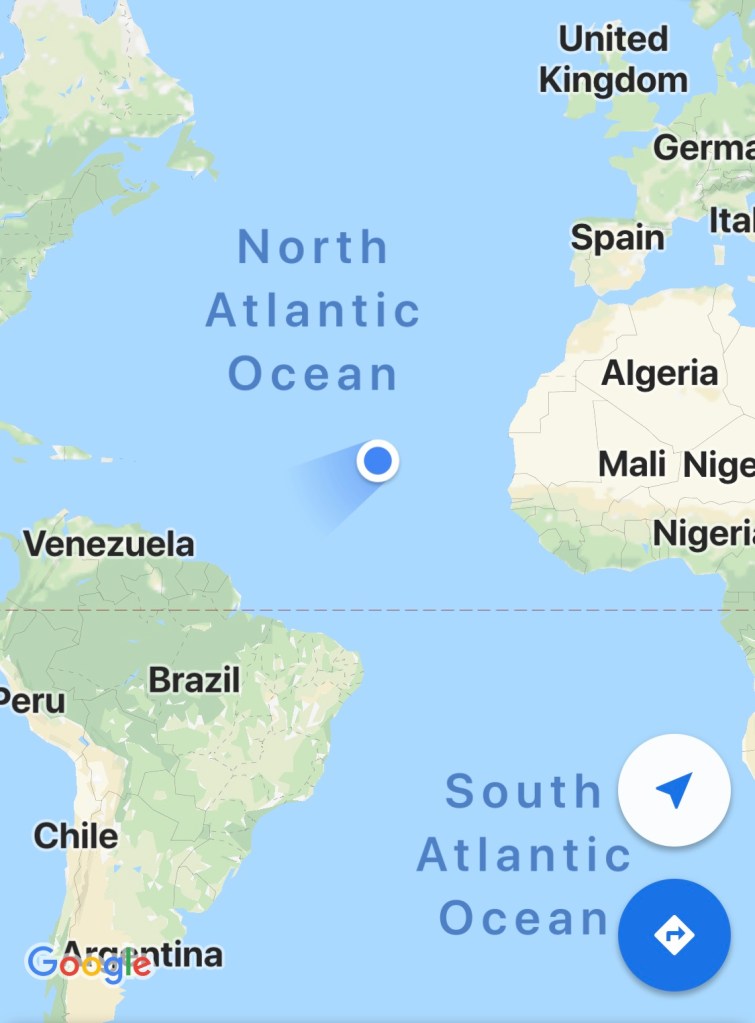
The distance from Mindelo, Cape Verde to St. Lucia is approximately 2,100 nautical miles. At our average of 6 knots per hour, that figures out to be about 14 days. Maintaining speed is based on the wind and the sails we are using. If we are not able to maintain this speed…it could mean many extra days…and need for more food, water, etc.
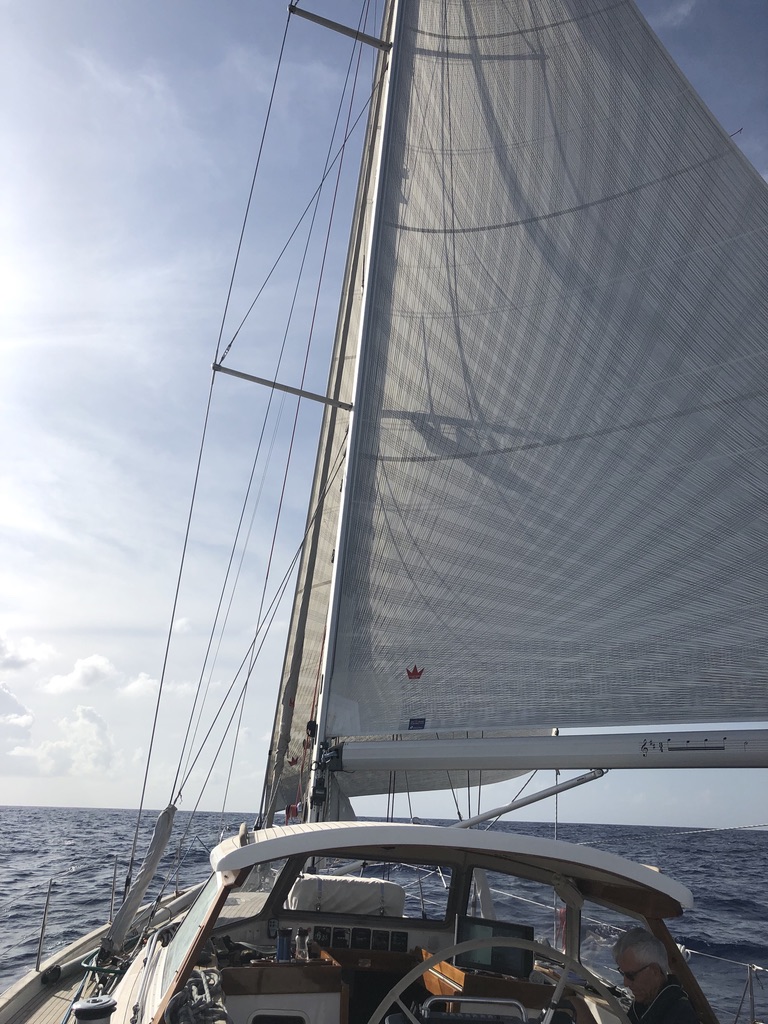
Since the trade winds used by the ancient mariners are well established in the Atlantic by this time of the year, we would expect wind predominately from the northeast. When crossing the Atlantic to the Caribbean from Cape Verde, the wind typically comes from behind the boat (downwind) and is PERFECT for our favorite sail, the Blue Water Runner (BWR) made by Elvstrom! This sail allows us to maintain an excellent speed. We can get as much as 8-9 knots per hour when the wind is up around 15-20 knots. It does involve using a Whisker Pole, though, which is a pole placed outward on one side of the mast and holds the windward side of the sail open. Otherwise, the sail will flap and flap as the relative wind changes. The whisker pole is an essential piece of equipment….as I will explain!
Sails and The Blue Water Runner
After setting the boat with the BWR, we lined up towards the starting line just outside Mindelo Marina in Cape Verd islands. We turned off the engine and tried to open the BWR sail. As Don, one of our guest crew, used the electric winch to pull the ‘sheet ‘ of the windward side of the BWR sail in order to open it, he met some resistance. Unfortunately, he insisted with the electric winch without paying attention to the fact that the pole was against one of the shrouds (a stainless steel cable that holds the mast straight up). The next thing we heard was a loud and awful cracking sound as our beloved (expensive) pole broke into 2 pieces. It was the biggest disappointment we had experienced in a long time. Our favorite sail was now benched and we would have a long hard ride to St. Lucia.
Being constrained to use our regular sails, the Genoa (front sail) and our main sail, we had to zig-zag along our course line. This meant many more miles even though we still kept up our average of 6 knots an hour. Our daily averages ranged between 130-160 miles a day, however it was a bitter pill to swallow since we often get 190 miles a day or more with the BWR.
Even more disappointing was that Don, who had not even been asked to share the expenses of the trip, as is commonly done on other boats, did not offer any apologies or show any initiative to help repair or mediate his several thousand dollar mistake. And it wasn’t only the financial damage, it was the issue of time and lack of resources to repair essential equipment. Unfortunately, the feeling that we had someone aboard who was so inconsiderate, cast a shadow over the whole passage for us.
With lighter winds (12-16 knots) we used our Code 0 sail, which is typically for upwind sailing, as our downwind sail by holding it out with the boom since we did not have a pole. It still flapped some but we maintained an average speed at around around 5-6 knots. Having imagination in a bad situation can produce some profitable ideas! Even though we could not follow a direct course, we could do shallow zig-zags and make good headway to our destination.

On the last leg of 700 nautical miles, we were dead downwind and decided to pull out the BWR at the insistent suggestion of our friend Captain Andy who had been emailing with Giorgio. We poled it out with the boom to stabilize it and made around 8 knots an hour.
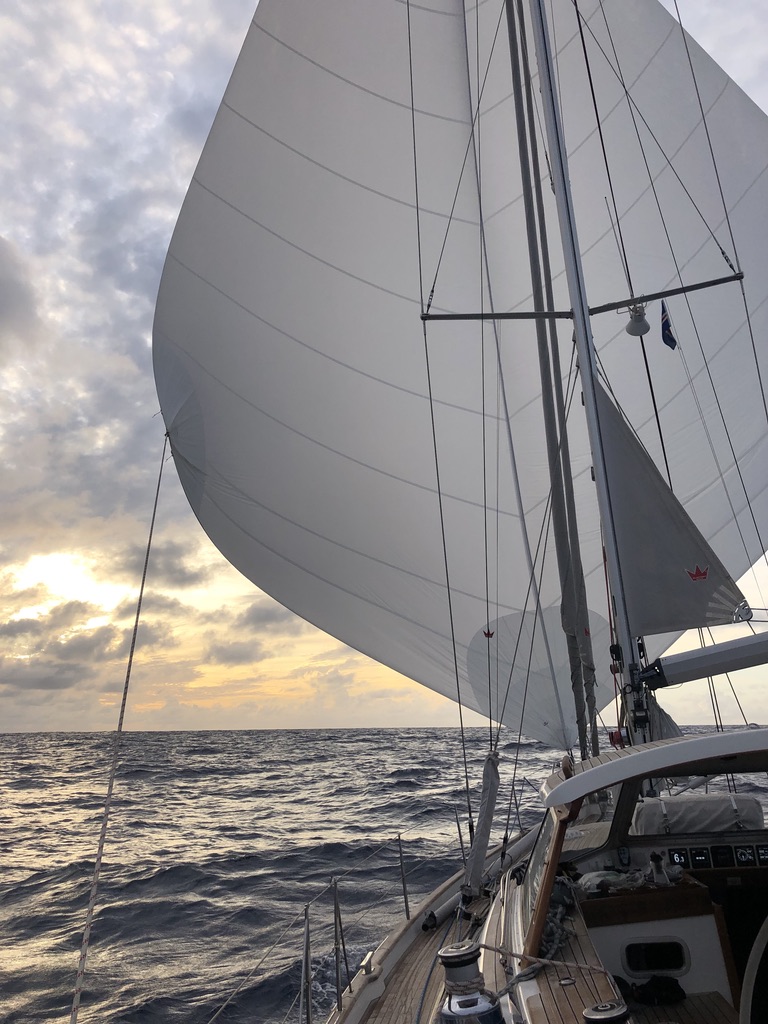
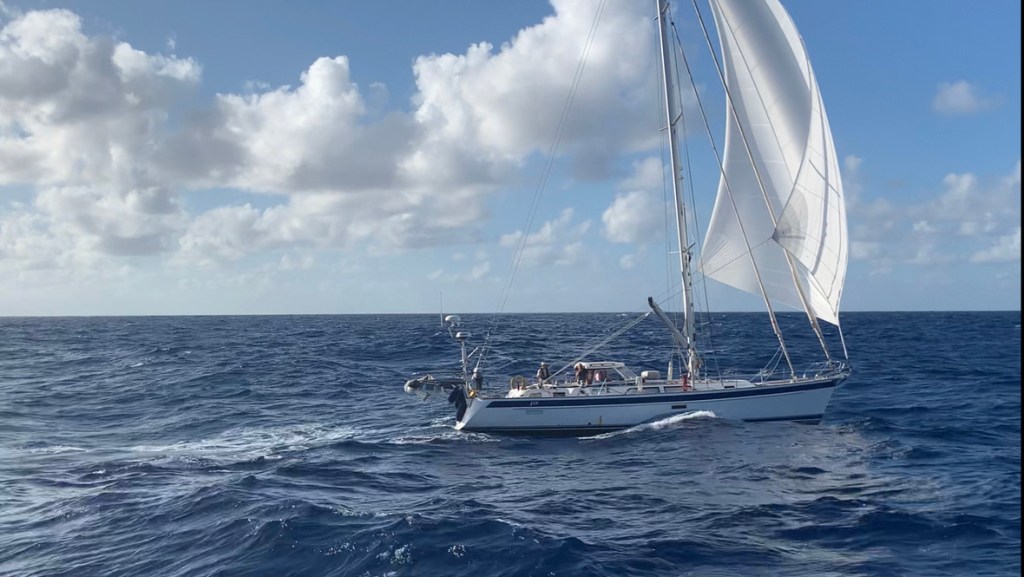
This is the way Giorgio describe SV JAN to other people: ” This is not a Porsche Carrera Turbo or a Ferrari, it is more like a Porsche Panamera or a very powerful Mercedes-Benz 4-door Sedan. She does the best with heavy wind, either downwind or upwind, and she takes a good speed as her hull lines adapt to the motion of the sea and the waves beautifully. Sometimes I wonder if we have too much sail up or if we are going too fast, then she talks to me gently and says “relax and let me go, I was designed for this by the #1 sailboat designer: Germán Freers”. In fact, the ride with this boat is very smooth and comfortable and you arrive maybe after the Porsche Carrera, but in much better shape and rested.
Water, Precious Water
Another problem we had was with our water maker. After leaving Las Palmas, we noticed that there was a small leak coming from the water maker. During a long passage, water is like gold for us. We mostly take this life-giving liquid for granted, but a few days on a boat in the middle of the ocean will help you realize how important it really is.
One common problem in most boats is there is so little space to put things and mount different systems. Our boat has several optional systems, one of which is the water maker. As you can see from the photo, this water maker installed by Hallberg-Rassy was placed in a area that is so tight that you cannot even access the side where the hoses connect, or even remove all the necessary screws which hold the other side closed.
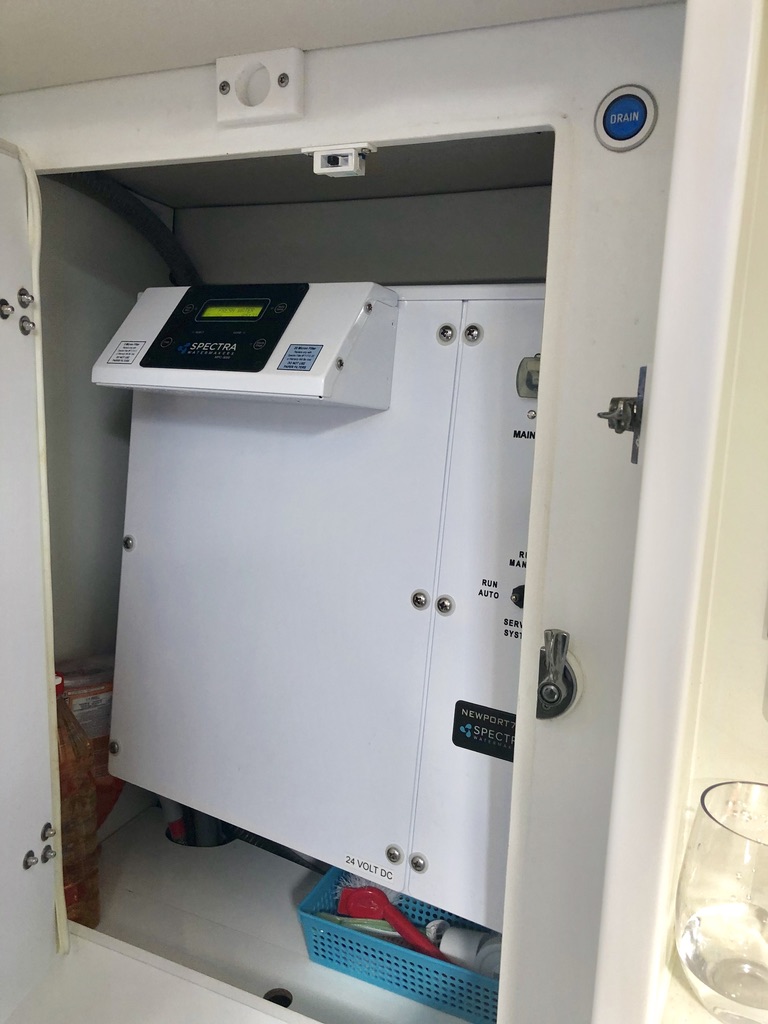
Using an extension mirror and the video on the cell phone, Giorgio identified that the leak was coming from a high pressure hose. It was getting worse each time we made water, and eventually became a steady spray. After contacting the manufacturer in California, it was suggested that we tighten the hose clamp which we did. It came off again. On the third tedious try we using two hose clamps and it is holding well. Fingers crossed!
So we temporarily solved our problem by tightening the hose clamps. We made water daily just to ensure that we had plenty of water to get us to St. Lucia should the water maker decide to give us problems again. Our tank capacity is 970 liters which we refill by making water when it reaches a minimum of 3/4 tank. We also carry about 100 liters of extra water in the bilge, just in case.
What did we do all day- and night?
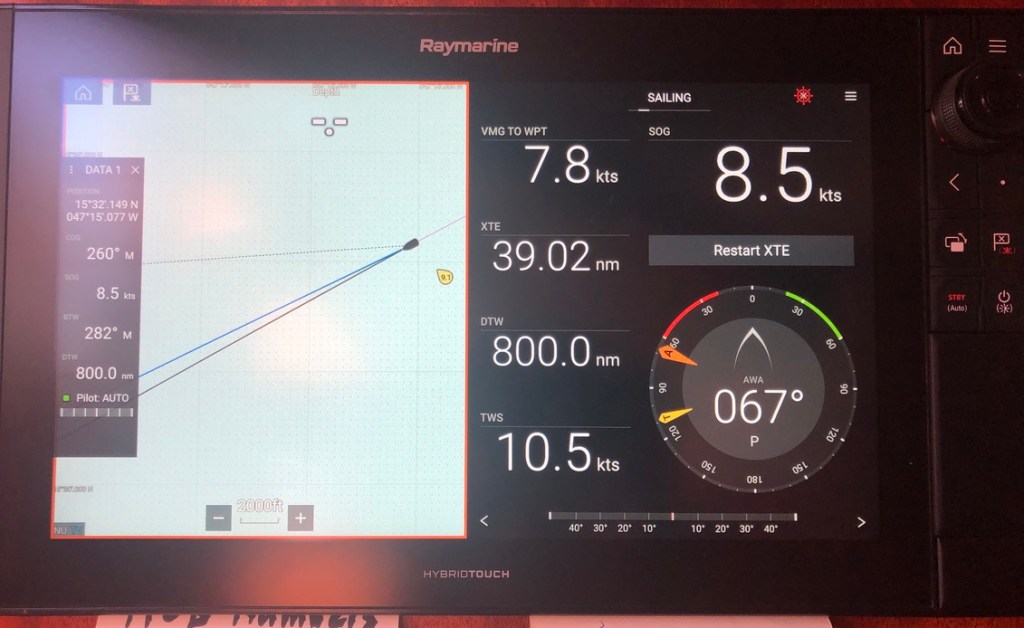
As I explained in the last post, we have shifts of 2 hours while on passage. This means we sit on watch near or at the helm of the boat. We check the sails, look at the monitor/ chart plotter, make sure we are on course, and look for other ships. Sometimes we have sail changes because we zig-zag to the wind, and other times we have to adjust the direction of the auto pilot as the wind moves. Over the past several days, we have seen only a few large ships and only a few sailboats from our group.
Unfortunately 3 days after the start of the rally, a skipper on one of the boats in our group of the ARC+ had a heart attack and died. We heard about it on our daily SSB Radio Net. I am not sure how the boat crew handled the situation, but we all had several days left in high seas when we were informed. This very sad news put all my disappointments into perspective!
Rock and Roll
The waves often roll the boat from side to side as much as 15-20 degrees from one side to the other. Things tend to fly all over the place! Thanks to the help of Tim, we tied down the crock pot so I wouldn’t lose the contents on the floor, as nearly happened a couple of times. I also tied down the bread maker. The stove is gimbaled so it stays horizontal with the movement of the boat but we still need to anchor the pans.

Animals of the sea!
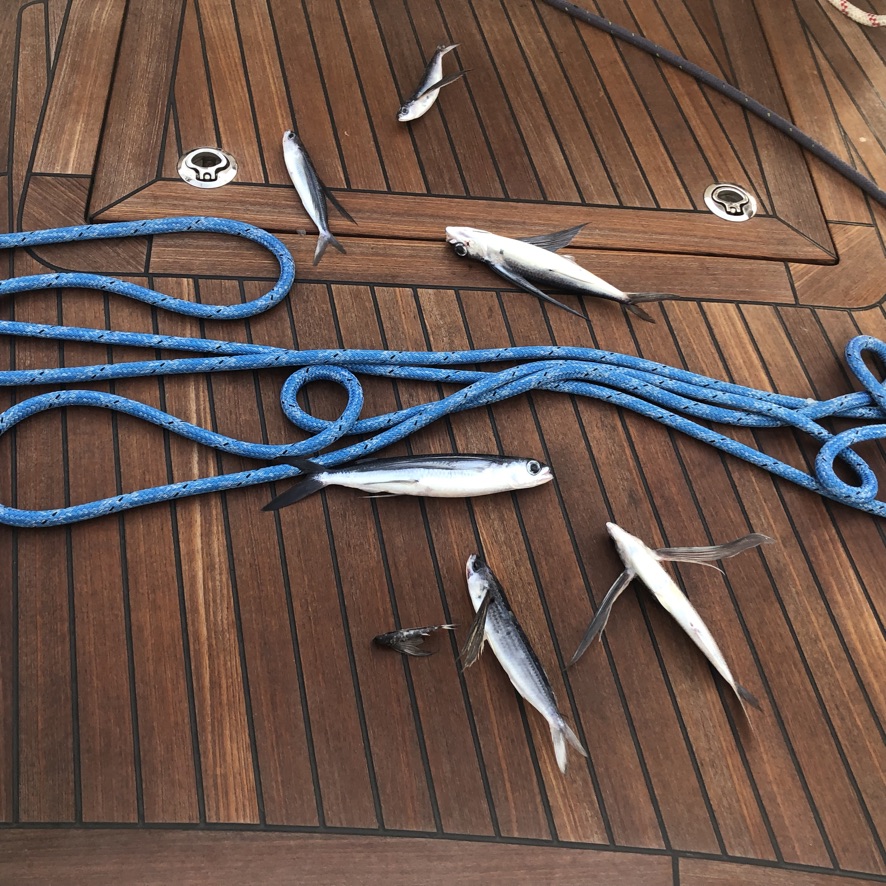
Flying fish were everywhere and were found on deck nearly every morning. They even made their way into both bathroom windows. Tim was brushing his teeth one night and a flying fish hit him right in the side of the head!
We have seen dolphins several times, although each time they did not stay around to socialize as they often do. One time we decided that one was probably being chased by something- maybe a shark. It is always a pleasure and an inspiration to have dolphins pop out of the water to greet us and especially if they decide to follow us for a bit.

One evening we saw a Sperm whale a few hundred feet from the boat. As he glided along, he would pop his head up and shoot a characteristic vertical misty spray.

Daily Bread
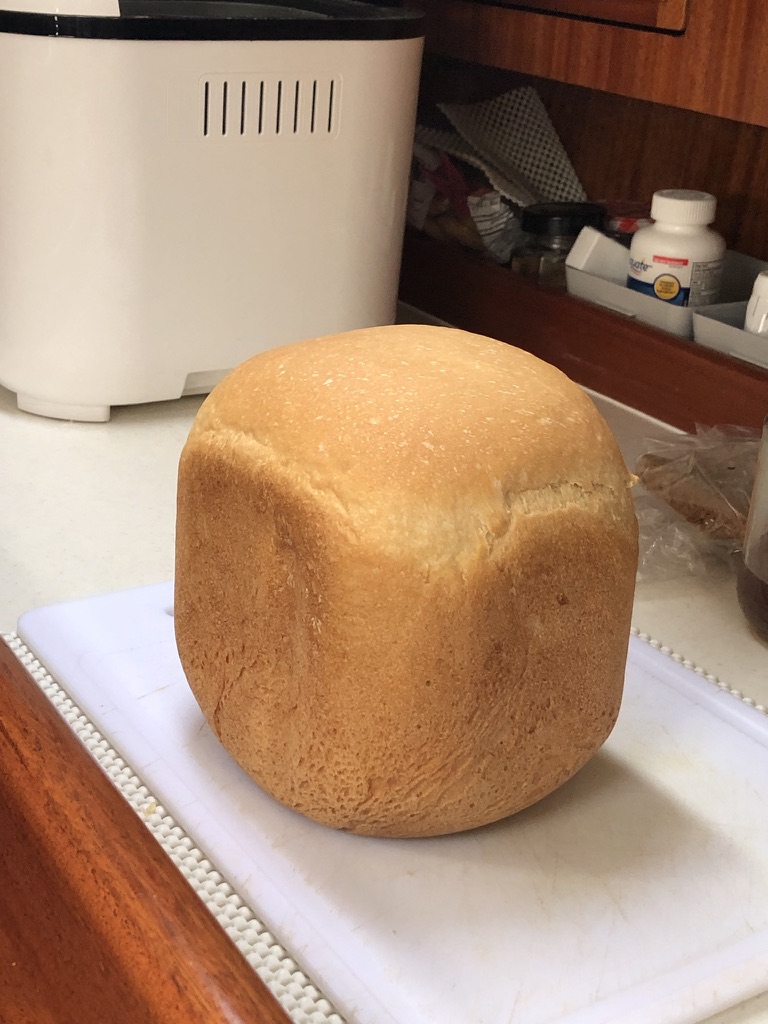
Our appetites are not as hearty on the boat as when we are on land. We usually ate a light breakfast of coffee and cereal. Then a sandwich for lunch. With the rolling of the boat it is always difficult to eat and cut meat on a plate, so I prepared one pot dinners that could be eaten with a bowl and a fork/spoon.
I did most of the cooking— which I enjoy. Pasta, chicken stews, soups, and fresh bread. The crock pot, bread maker, rice cooker and pressure cooker were used daily. One day I made chili and on Thanksgiving (also Giorgio’s birthday), I made a turkey dinner with sweet potatoes, dressing and turkey. That was also the day we reached the halfway mark- 1,050 nm.
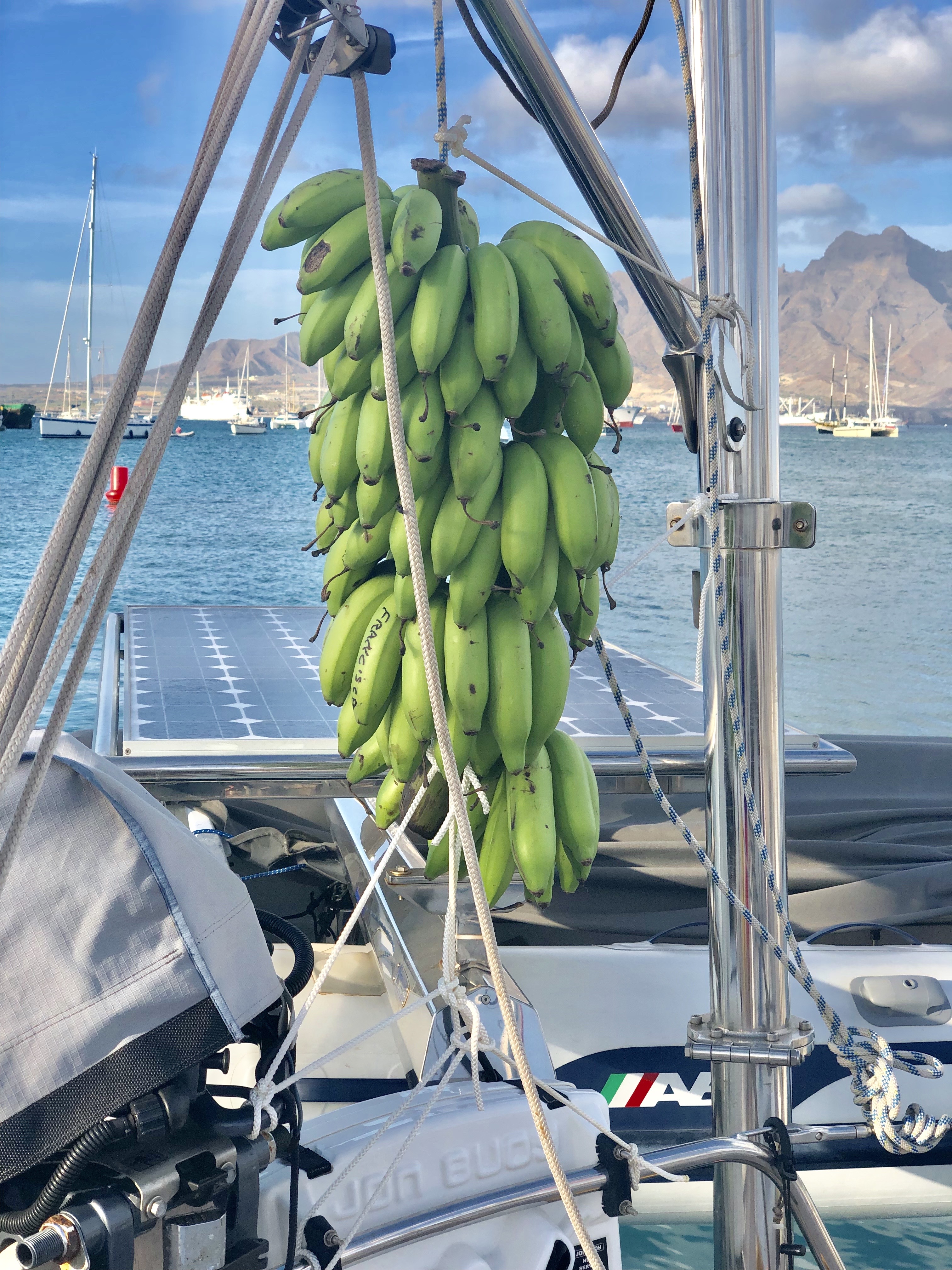
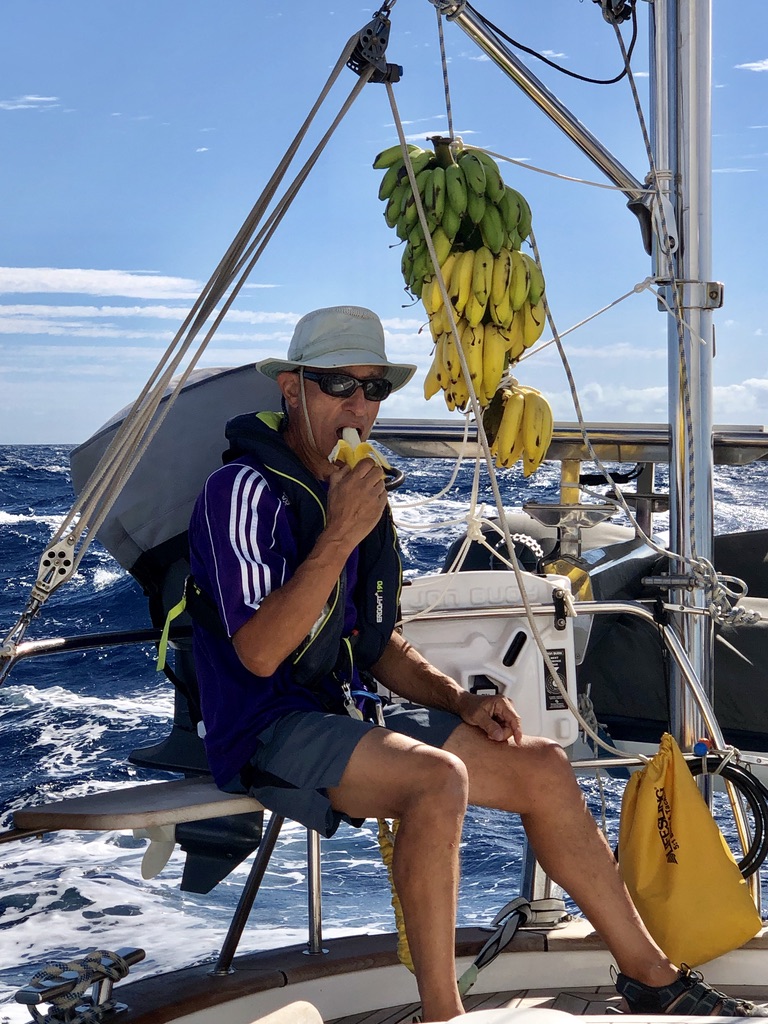
We started with a huge bunch of bananas and papayas since they ripen the quickest. We stored our bananas suspended on the stern of the boat. The bananas were all eaten after 12 days and there were none left for banana bread. We have lots of pears and apples, too. Today we cooked apples in the crockpot. I try to never waste food!
Large hanging nets in the boat provide extra storage space for onions, apples, potatoes, and cabbage.

Communicating to land and sea
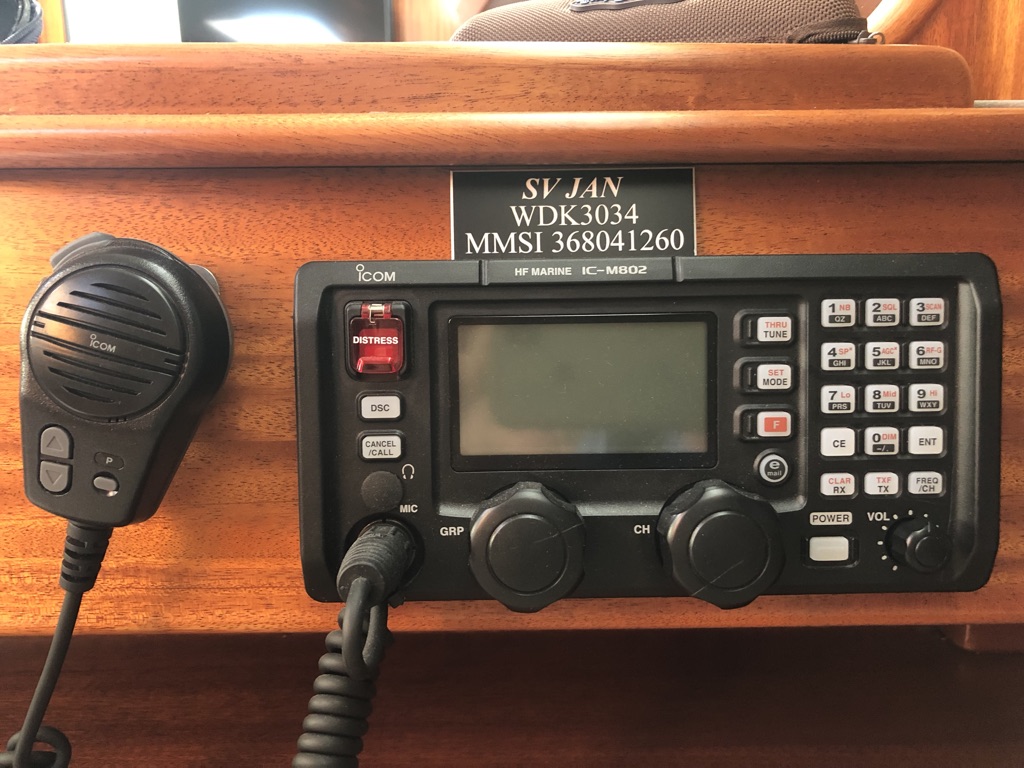
Our SSB (single side band) radio is good for communicating for up to several thousand miles depending on the time of day. We used the SSB for daily talks with the rally and sending emails. Our friend Franco Vigna emailed almost daily with routing suggestions based on the weather. We really appreciated his efforts. Giorgio obtained daily weather GRIB files in order to make decisions on the course and headings.
We also have an Iridium Pilot Satellite system which we use occasionally since the data cost is quite elevated, compared to the SSB which is free!
Navigating and Weather maps
You probably are wondering if we get tired steering the boat. It is a lot of work and concentration to steer the boat for days and days. Well, for that we have 2 autopilots- one to use most of the time, and an extra one if the first one fails!
We also have three chart plotters with maps and a GPS connection to show our position on the map and which also shows other traffic in the area we are in.
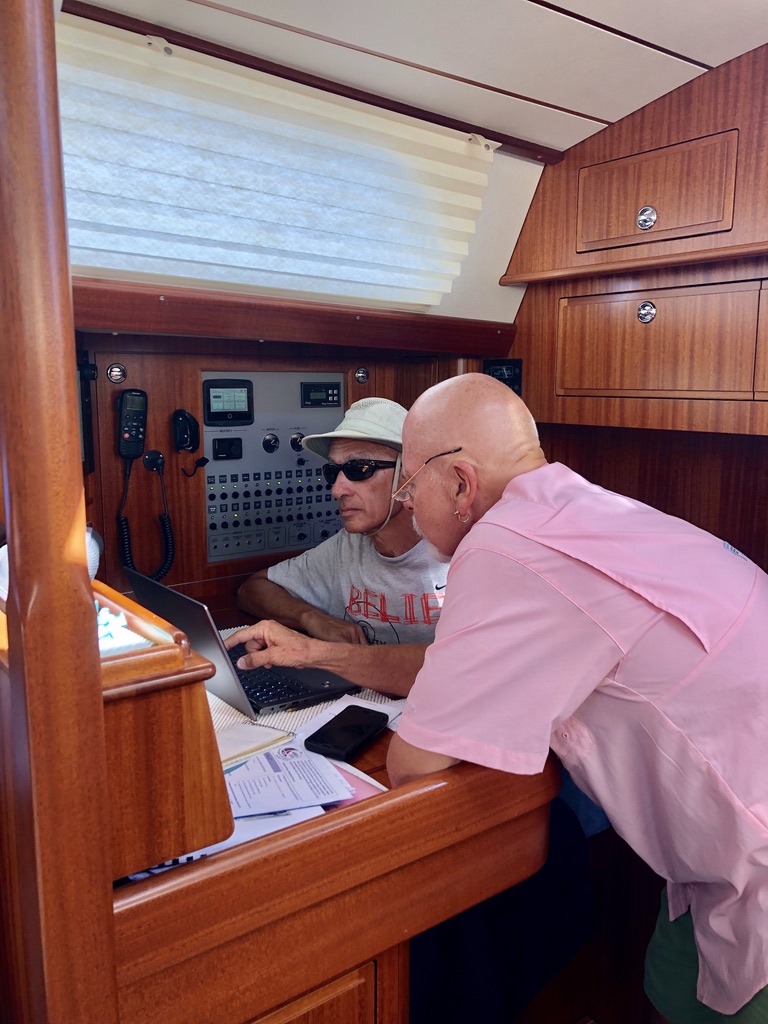
As I said, Giorgio gets daily written updates on the weather from the ARC office. He also downloads weather maps via grib files obtained by email from the PACTOR Modem and the SSB. If we need to we can also download grib files from the Iridium Pilot.
The SKY
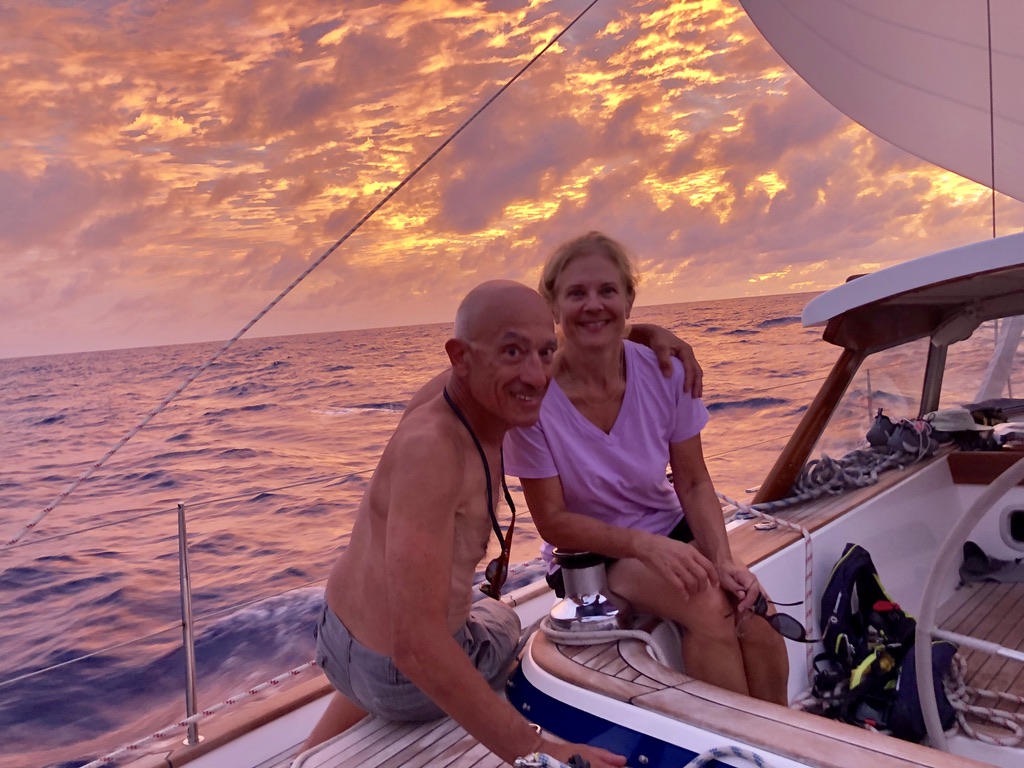
The sky day or night is spectacular. Enchanting. The colors are so dense and pure that it seems impossible they are natural: reds, oranges, yellows, blues, greens, and greys. Last night there were so many stars that they twinkled all the way to the horizon. It almost seemed as if they were lights of other boats, but then I realized they were really stars. And philosophically, looking at the night sky makes every worry we have seem trivial, as we are only a speckle in this vast universe of infinite universes.
Another miracle in the night is to watch the florescent green sparkles in the wake of the boat as it glides through the water. Like fairy dust trailing us. Magical.
Why do people do this?
This is a question that I have been asking myself. In addition to the nearly 300 boats in the ARC rally to the Caribbean this year, there are thousands of boats around the world at any given time crossing oceans or simply cruising islands or seas. There are so many of us! In addition, these participants are mostly professionals from many different backgrounds: doctors, CEOS of different businesses, entrepreneurs, lawyers, architects, engineers, retirees, etc. Some of them continue to work while cruising using a good internet connection. Others took a sabbatical to fulfill their dream. They are not crazy people, they are highly motivated, passionate people who have chosen sailing as their way to take calculated risks in life.
We did not Fall off the earth! Arrival to St. Lucia after 14 days at sea
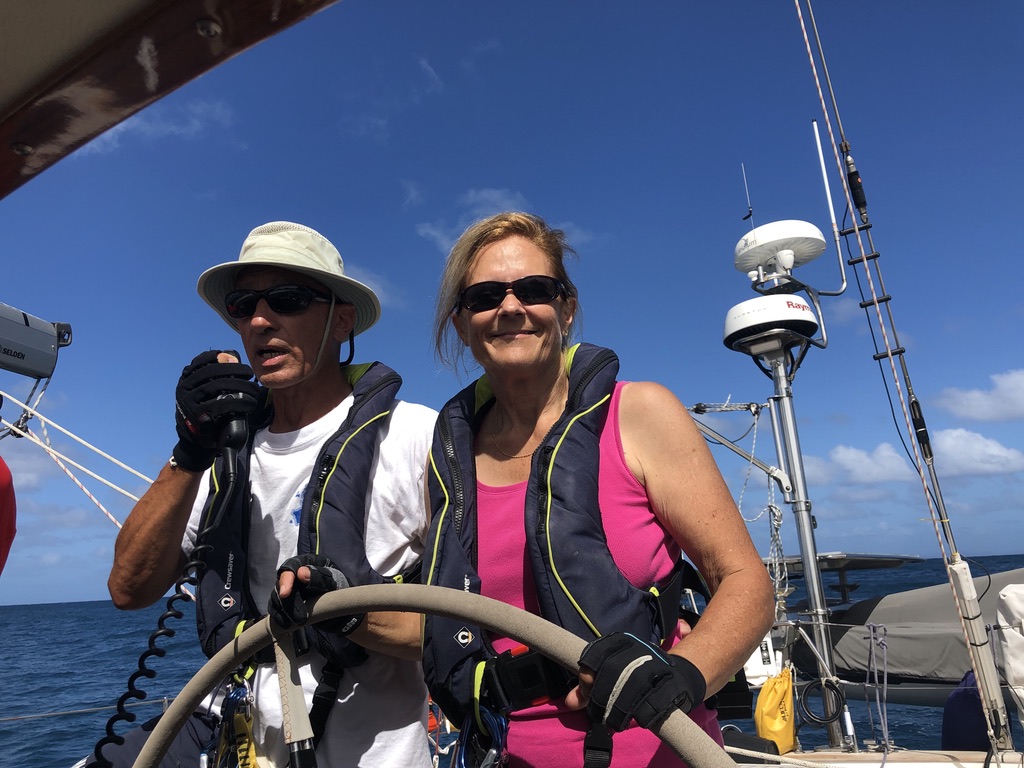
We arrived in St. Lucia around noon on the 5th of December. Despite the breaking of our whisker pole at the departure, we still made the passage in 14 days! However, our arrival was not pretty either, since we were unable to furl completely the BWR and the sail continued to catch wind after we opened the Genoa and flapped terribly in 25 knots of wind. There was a lot of horrible noise as the sail banged and banged against the top of the mast. In fact, the flapping created severe damage to the sheave which is the system that guides the halyard through the mast. Another big problem we will have to fix before leaving the Caribbean.
Even though our beloved SV JAN had some significant damage, no person suffered any bodily injuries and for that we are very grateful!


 The Adventures of SV JAN