
What is a refit?
Sailboats require continuous maintenance!
The marine environment (sun, salt, humidity) quickly degrades many things on boats— certain metals, precious woods, paint, hoses, and electrical wiring. Similarly, certain items in a house have a limited lifespan, and eventually, they need to be repaired or replaced.
Since we left the boatyard in Ellös, Sweden, we have traveled more than 35,000 nautical miles. Of those, 90% were sailed in different sea and wind conditions—mostly moderate but sometimes heavy. Only 10% were motored, mainly in the Mediterranean, Alaska, and British Columbia, where the winds are often not helpful for hopping from island to island.
The definition of “refit” implies a detailed overhaul of all the boat’s main systems: mast, engines, generators, hydraulics, transmission, propellers, electronics, and the paint on the hull and upper structure. After a refit, most boats can cruise extensively for several more years. We choose Westhaven Marina in Auckland and Marsden Cove dry dock for this refit.
Mast and standing rigging
Most insurance companies expect owners to replace the “standing rigging” on their sailboats every 10 years. The“standing rigging” is all the wires that support the mast.
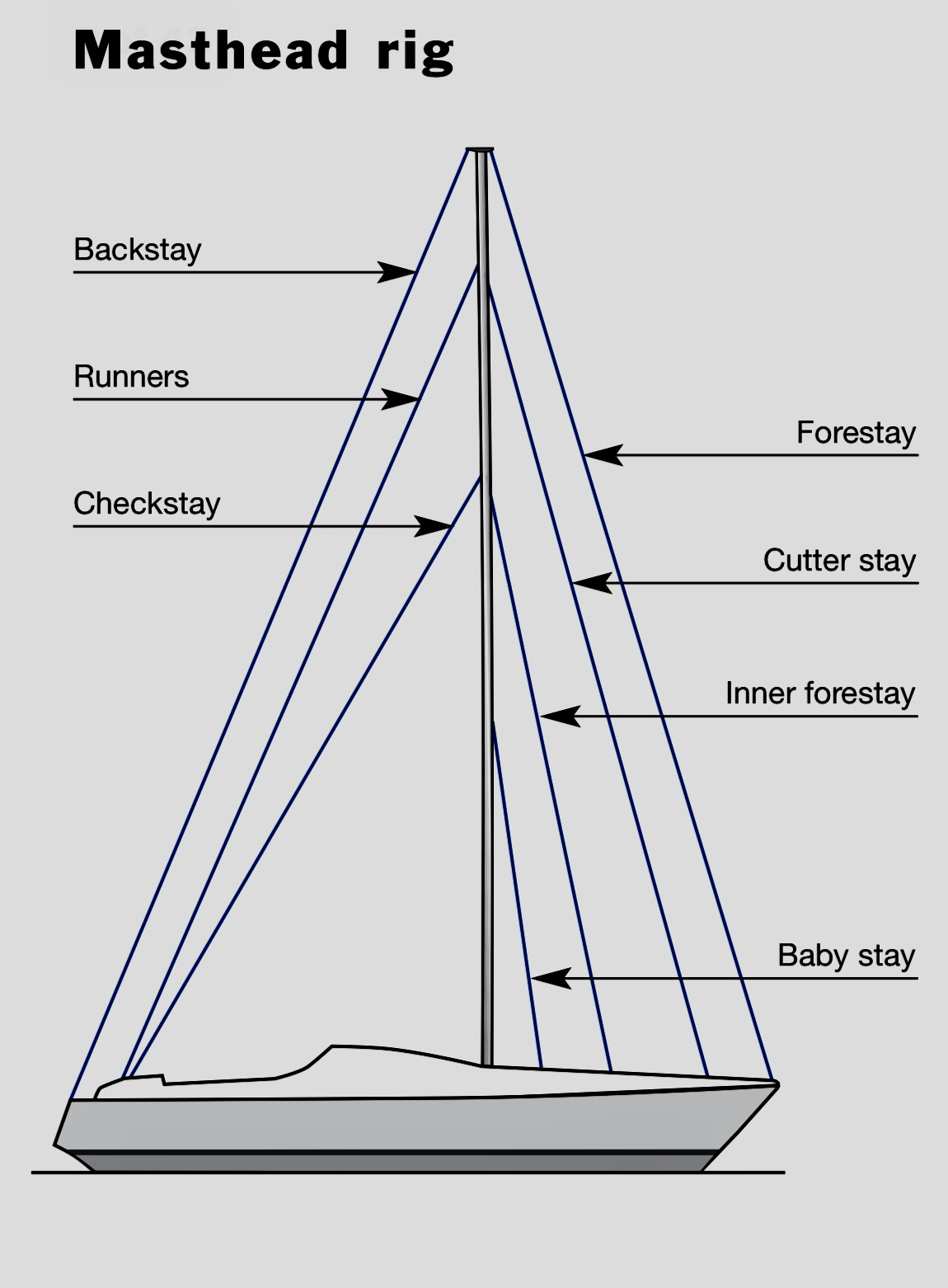
Our mast is quite complex, having three orders of spreaders and a total of 17 wires of different diameters, from eight to 14 mm. From the bow to the stern, they include the forestay, the cutter stay, the cap shrouds V1-V3, D4 X2, the intermediate shrouds D2, D3 X2, the lower shrouds D1F-D1A X2, and finally the backstay.

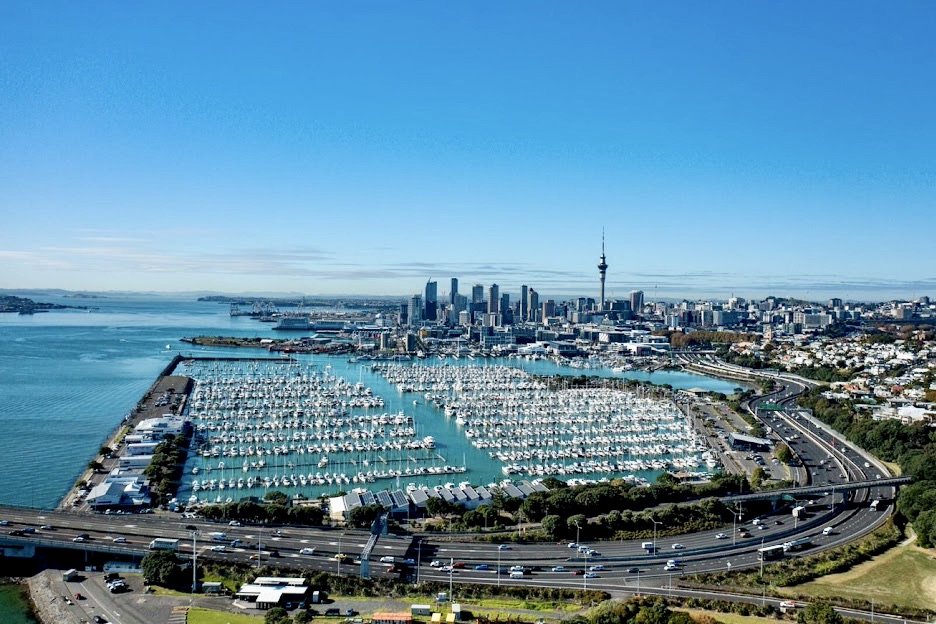
Over the past six years, since we departed with the boat from Sweden, we had yearly rig inspections and found that many riggers were unfamiliar with this kind of mast and its tuning. On the other hand, New Zealand has many boats with complex rigs, and competent, knowledgeable riggers are easy to find. Qualified facilities are plentiful—many super yachts, cruising yearly in the South Pacific, usually choose New Zealand for regular maintenance and repairs.
Our plan is to sail back from New Zealand to the Pacific Northwest in 2025, and this would total about 7,300 nautical miles, divided into three long legs: Auckland to Tahiti, Tahiti to Honolulu, and Honolulu to Victoria, British Columbia. Calculating an average of 170 nautical miles every 24 hours, we would be on high seas for at least 43 days. Of these, the first leg from New Zealand to Tahiti often includes several days of heavy winds averaging 30 knots both from the stern and from the bow!
For this reason, and also because there are very few good riggers and boatyards in Tahiti, Hawaii, and the Pacific Northwest, we decided to proceed with this job.
Westhaven Marina, Auckland
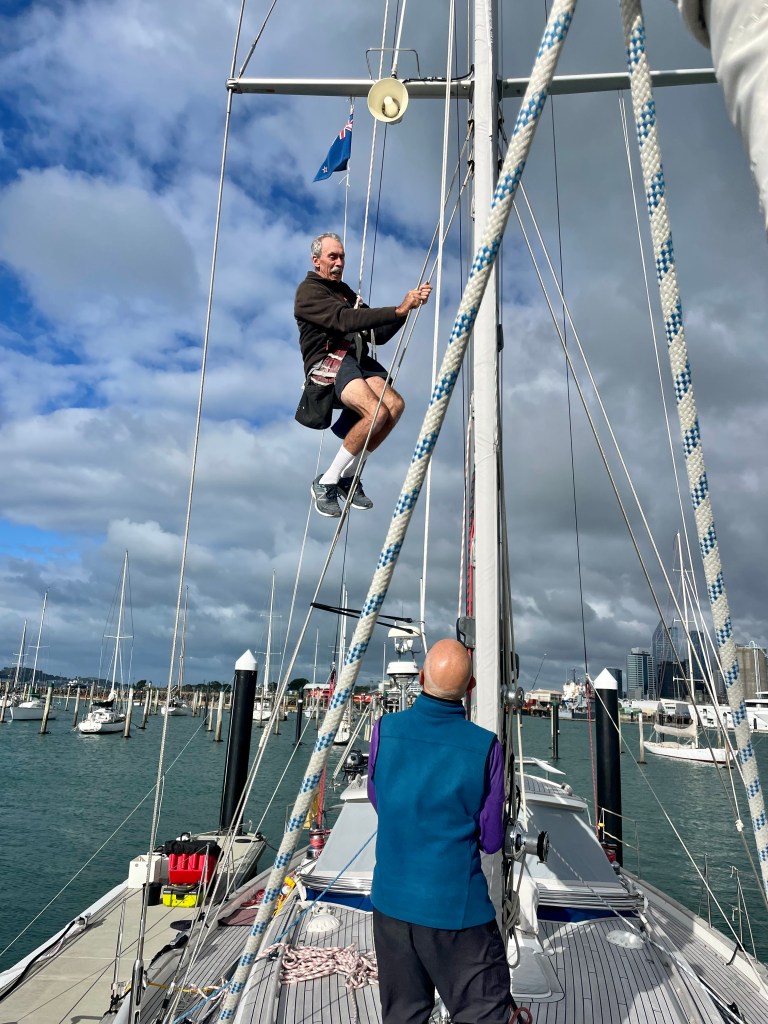
Steve Ashley, a Kiwi Rigger.
After asking the professional sailing community for recommendations on the best Auckland riggers, we chose Steve Ashley from The Rigging Shop to replace the standing rigging in SV JAN. When he came aboard our boat the first time, he said that our standing rigging was in good condition and that we could easily wait four more years. However, we explained to him that we wanted to proceed with the job because we may be sailing back to the Pacific Northwest next year. He agreed with the plan.
Steve Ashley is a true Kiwi! He has worked in the boating environment his entire life. Initially a delivery captain for many years, taking boats all around the South Pacific area, he then worked in England and New Zealand as a sailmaker at North Sails. Later, Steve opened one of the most successful rigging businesses in Auckland, The Rigging Shop. He became a mentor to many young riggers.
Steve is over 60 but climbs the mast using his arms and legs, using a halyard as a safety line: Giorgio pulled the slack off the halyard as Steve hoisted himself up.
As a true Kiwi, he always wears shorts, even if it’s cold outside!
Steve replaced the standing rigging on SV JAN with great competence and ease. The only parts he did not replace were the V1 shrouds, which a rigger in Tahiti replaced one year ago. The total bill was less than 1/3 of what we would have paid in Europe or the US!

After completing the job, Steve sailed with us for an hour to test the rig in dynamic conditions and make adjustments. He did not charge us anything for this sea trial! Needless to say, we became good friends.
Lithium anyone?
Hallberg-Rassy advised us to choose US-made Trojan batteries for our electricity house bank when the boat was under construction. They told us that we could easily find replacement batteries, if needed, in the most remote places in the world. Trojan batteries are lead-acid and not sealed. They installed 14 of them. [We also have five sealed AGM batteries dedicated to starting the engine, the generator, and activating the stern and bow thrusters.]
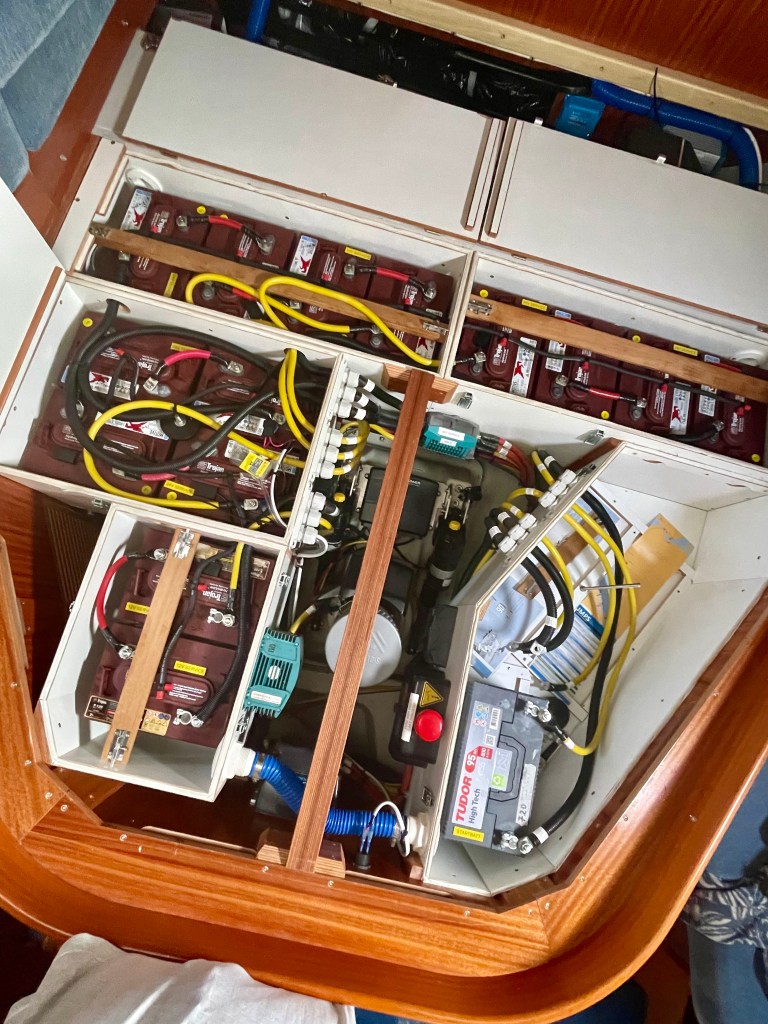
The unsealed Trojan batteries proved to be a poor choice since they require continuous maintenance. You must check the water levels in each battery at least once a month and replace the distilled water that evaporated during charging. Since they were located under our bed, every time we checked them, we had to remove the bedding and mattresses. The first set of 14 batteries lasted only three years, and the second set less than that. In addition, contrary to what Hallberg-Rassy told us, finding these batteries in French Polynesia and other Pacific Islands was impossible for us.
Beacon Marine Electronics
After arriving in Auckland, a fellow sailor advised us to consult Beacon Marine Electronics.
Cam and Kiel came aboard, tested the old batteries, and found that two were at the end of their cycle.
Jan and I were tired of the maintenance required by the Trojan batteries, so we decided to go for lithium. We chose the Mastervolt lithium batteries since most of our electronics and chargers/inverters are Mastervolt. Kiel was familiar with the brand, having worked at Mastervolt for years. They also advised us to add a new charger to the original 100A charger/inverter to cut in half the charging time using the generator.
The job required several days of work. Our bedroom saw a continuous activity of 2-5 people, including the cabinet maker who built a new box for the two lithium batteries. These batteries have the advantage of charging much faster and discharging almost to zero percent. The previous lead-acid batteries needed a much longer generator run and couldn’t be discharged more than 50%. In addition, the two new lithium batteries require no maintenance, store more electricity, and are almost 600 lbs (266 kg) lighter than the 14 acid-lead batteries of the original house bank—the weight of four people less on the stern of the boat!
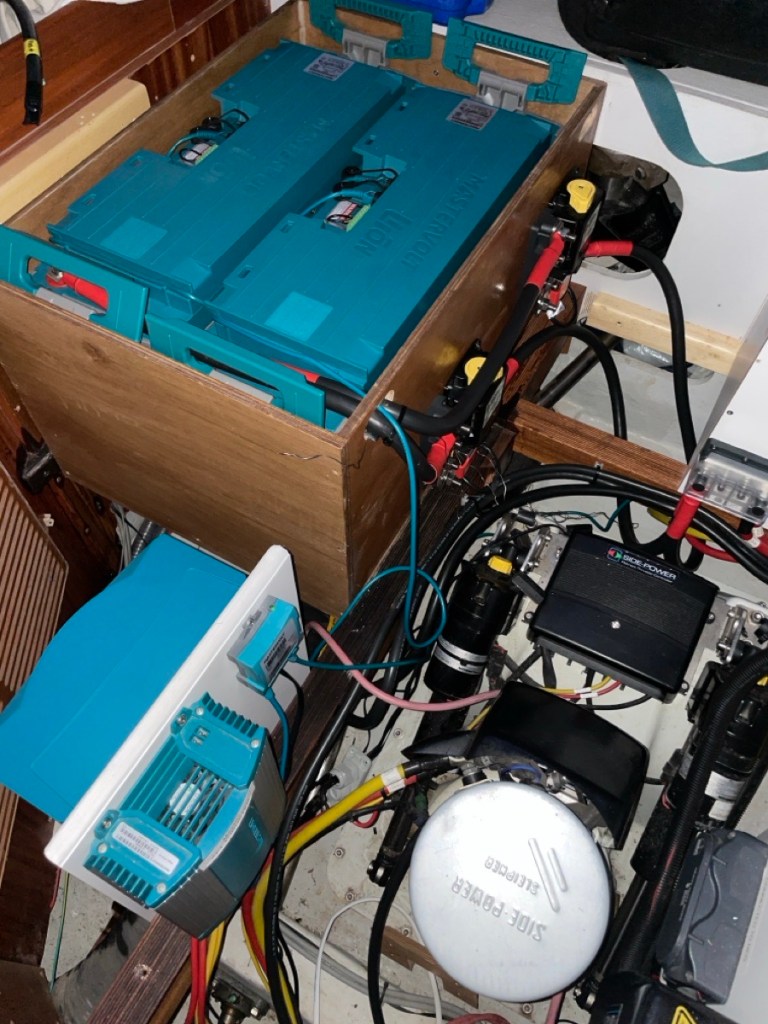
Unexpectedly, after they completed the installation, the original charger/220v inverter started malfunctioning, so they replaced it. We have now two new chargers and two new high-capacity batteries.
Overall, our experience with Beacon Marine has been quite positive, and we are now enjoying having more electricity with a shorter generator run.
In addition to the standing rigging and batteries, we also replaced the Spectra watermaker electric motor and overhauled the hydraulic systems for the opening and closing of the sails. Both technicians were very professional.
Hauling Out in Marsden Cove Marina
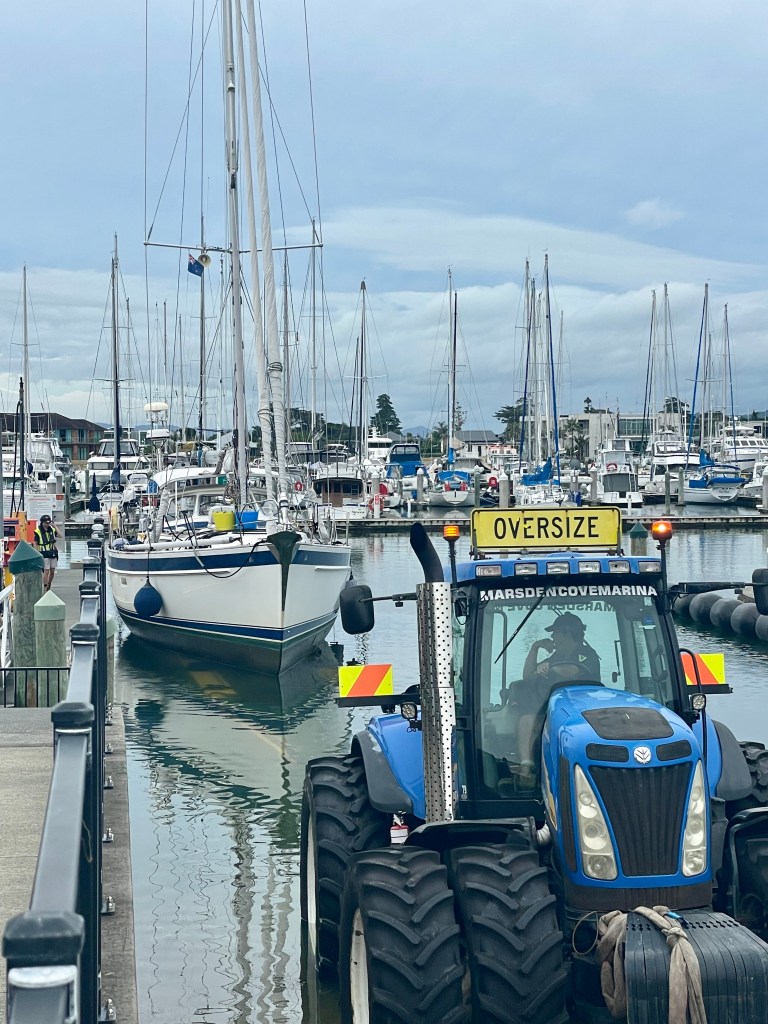
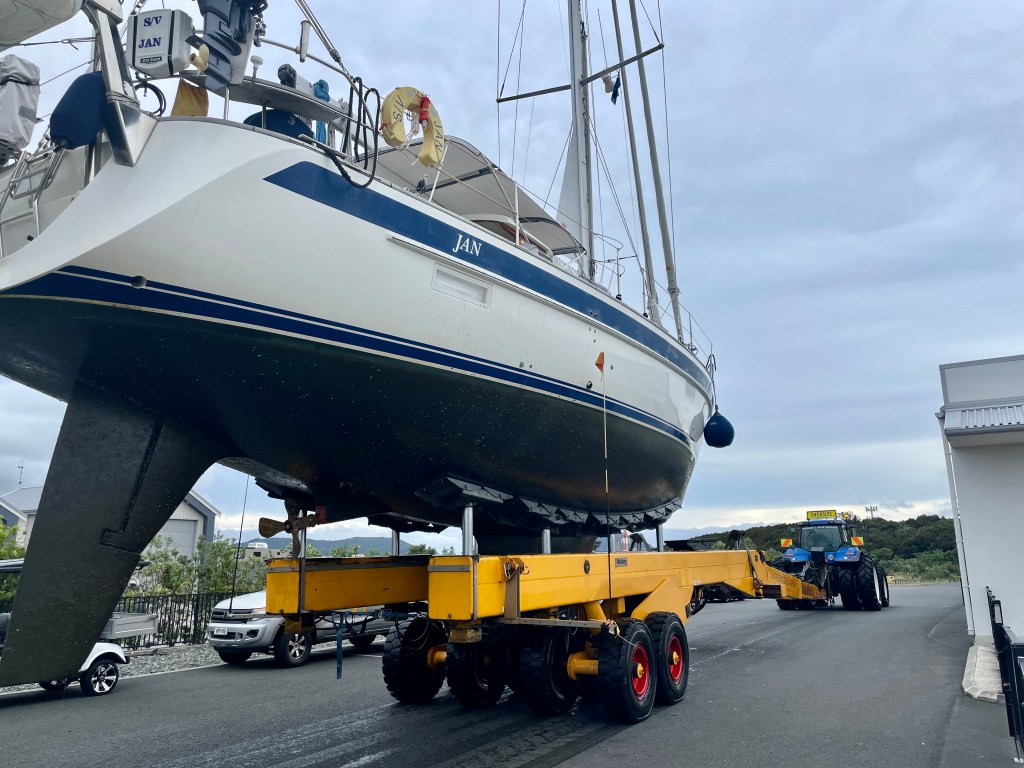
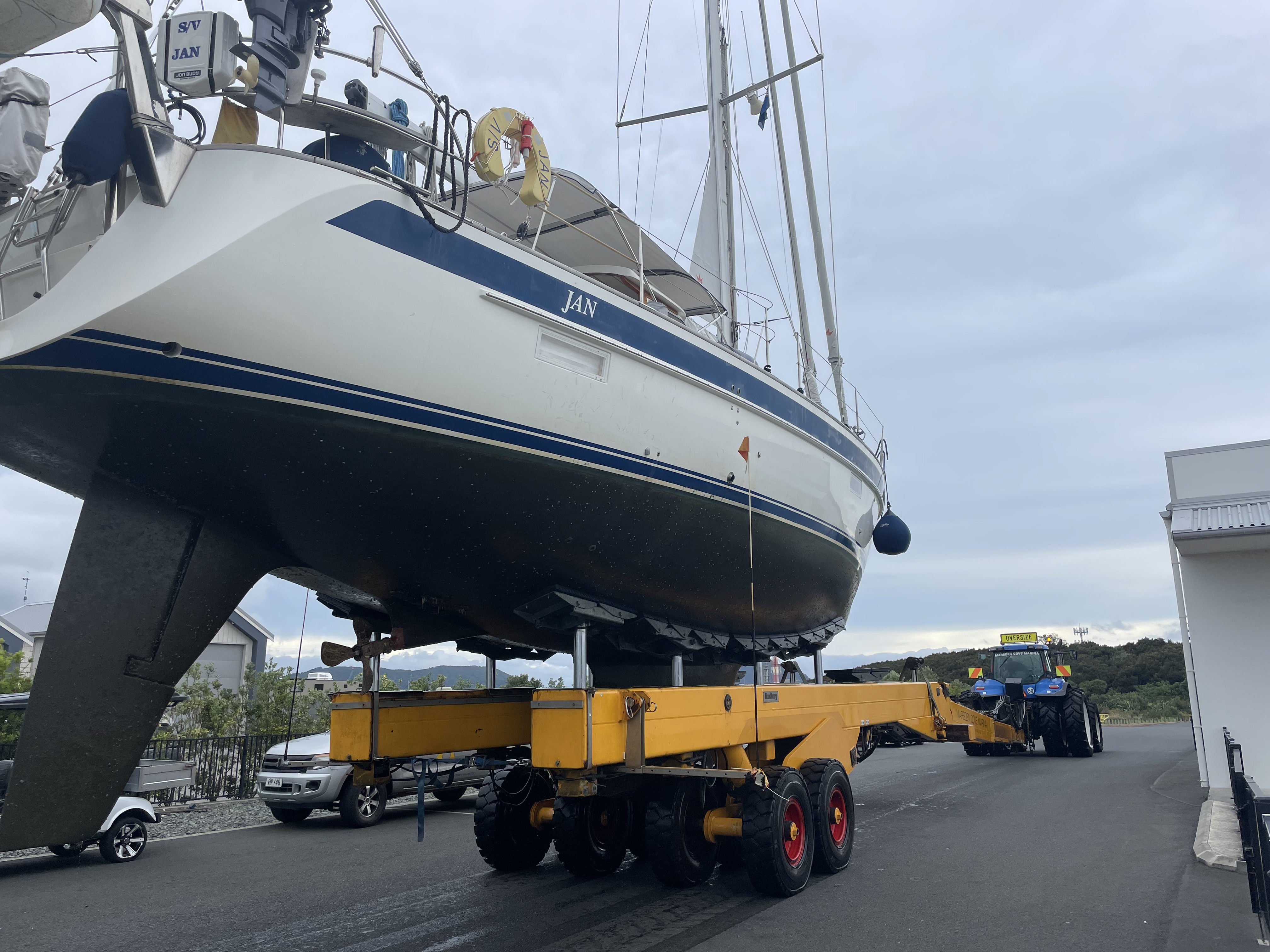
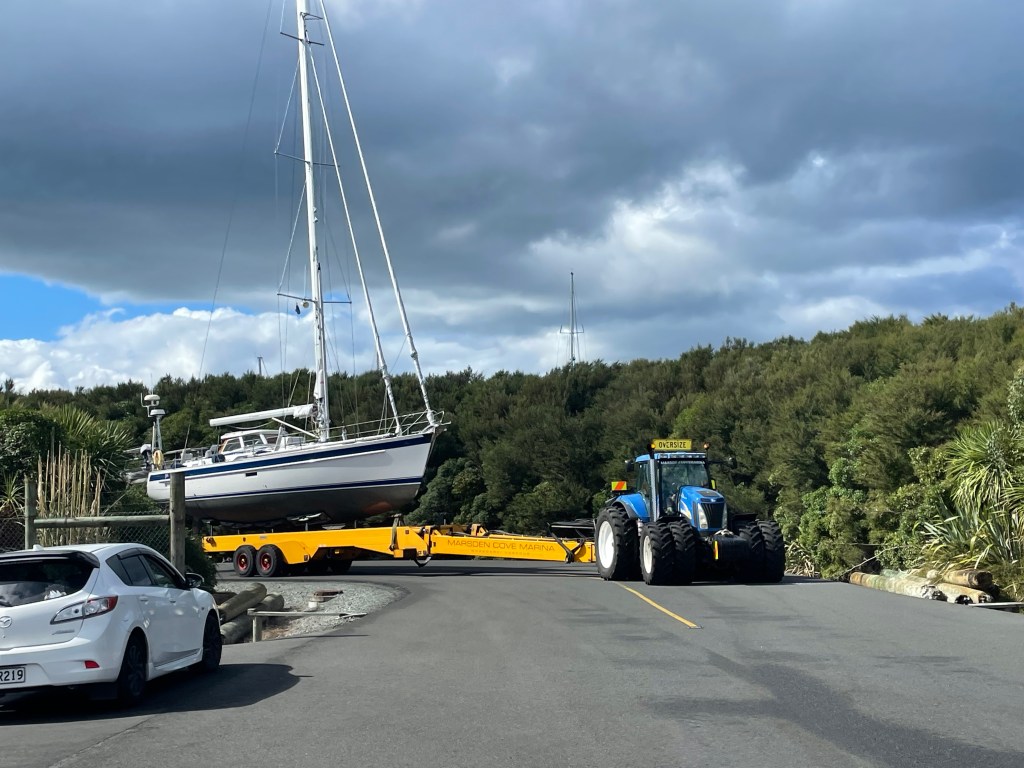
Located 70nm north of Auckland in the Whāngerei Harbor, Marsden Cove is our favorite marina in New Zealand for hauling out. It is a modern marina with top-notch facilities and a well-managed dry dock. The efficiency of the haul-out crew and equipment was far superior to what we had experienced in our travels across the Atlantic and the Pacific. They don’t use the Travelift system but the a new Roodberg hydraulic slipway trailer. What can usually be very stressful was an excellent experience for us.
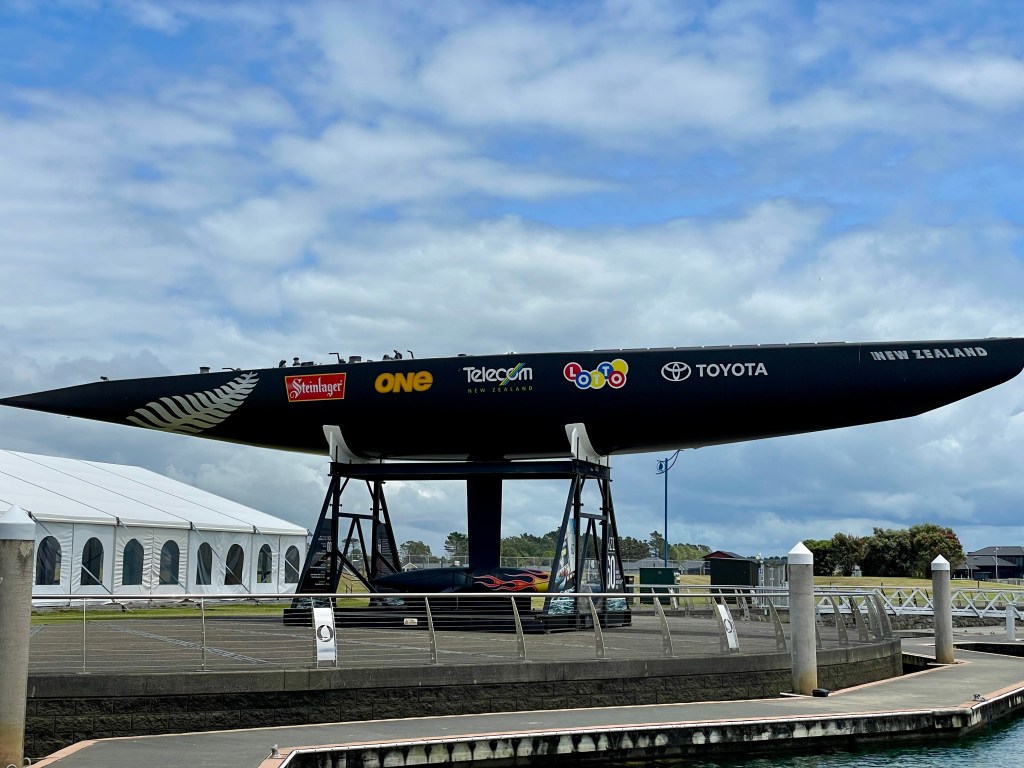
The presence of numerous companies, all equipped and ready to address any repair or improvement needed, instilled a strong sense of security and trust in us. While on the hard, we took advantage of having competent workers take care of our boat. Abel Marine polished the boat and stainless steel, repainted the aluminum window frames, and refreshed the CopperCoat bottom paint. Also the propeller received a new coat of Propspeed.
In the end, SV JAN looked like new!


 The Adventures of SV JAN